Logo, brand identity, brand guidelines: what each one is, what goes in a brand kit, and what a small business really needs to get started.
“Can you do a logo for us?” is the most common request we hear. And often, the thing the business really needs sits one level up: a brand identity. The words get mixed up all the time, even by people who work in design, so here’s a plain-language guide.
Three words, three different things
A logo is the mark that identifies your business. It might be a symbol, a wordmark (your name set in a particular style), or both together.
A brand identity is the whole visual and verbal system around that mark: the colours, fonts, photography style, graphic elements, and the way you write and speak. It’s what makes everything you put out look and sound like it came from the same place.
Brand guidelines are the instruction manual. They’re the written rules that say how to use all of the above, so anyone who touches your brand, from a designer to a printer to your cousin who runs your social pages, gets it right.
A helpful way to think about it: if your brand were a person, the logo is their signature, the identity is their wardrobe, voice and manner, and the guidelines are the notes you’d hand to someone who has to speak for them.
Why not just a logo?
A logo on its own can be enough when you’re starting out, testing an idea, or you only need a simple mark for a small project. But the moment you need a flyer, a website, a social post, packaging and a shop sign, you start making dozens of small decisions. Which blue? Which font? Is the logo on a photo or a plain background? Who decides?
Without a system, every new piece is a guess, and the guesses add up to a business that looks slightly different everywhere. People take that as a sign of being small or unreliable, even when you’re neither.
A brand identity makes those decisions once. After that, new pieces take less time and look more like you.
What goes in a brand kit
Different studios package it differently, but a solid small-business kit usually covers these parts.
1. Logo versions
One logo is never enough. You’ll typically want:
- A primary version, used most often.
- A horizontal and a stacked version, for different spaces.
- A small, simple version for tiny places like social profile pictures and browser tabs.
- Full-colour, one-colour, and black-and-white versions.
- Versions for light and dark backgrounds.
- Clear space and minimum size rules, so it’s never squashed or crowded.
2. Colour palette
A small set of colours: a main one or two, a couple of supporting ones, and neutrals for text and backgrounds. A good palette lists exact values for screen and for print, so your blue on the website matches your blue on the van.
3. Typography
Usually two fonts: one for headings, one for body text, with rules for sizes and spacing. Make sure they’re fonts you’re licensed to use in the places you’ll use them, and that there’s a sensible fallback for places that can’t load them, such as email.
4. Imagery and graphic style
What your photos look like (bright and natural? moody? close-up?), what kind of illustration or icons you use, and any patterns, shapes or textures that belong to you. This is the part that keeps a social feed looking like one brand.
5. Voice and tone
How you write and talk: the words you use and avoid, how friendly or formal you are, how you greet and sign off. It’s the verbal half of your identity and often the most neglected.
6. Templates and applications
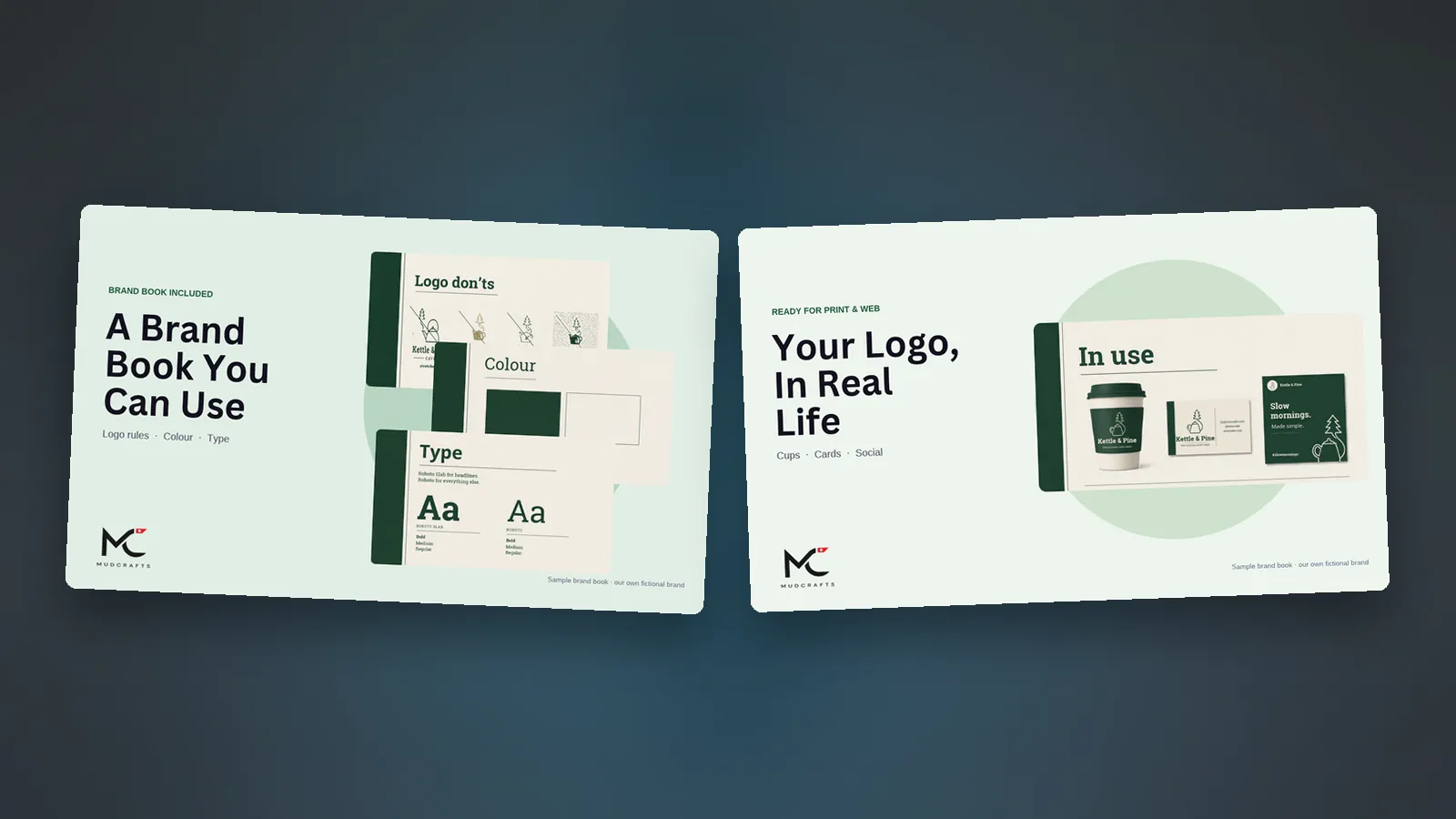
Ready-to-use layouts for the things you make over and over: business cards, letterhead, invoices, social posts, email signatures, signage, packaging. Templates are where an identity pays for itself, because they let you stay consistent without redesigning every time.
And the guidelines?
Your guidelines pull the lot into one document. For a small business, that doesn’t have to be a huge book. A clear few pages can be perfect: the logo versions and rules, the palette, the fonts, a few examples of “do” and “don’t”, and a short note on voice.
What matters is that it’s written down and easy to find. Future you, a new team member, or an outside designer should be able to pick it up and get it right on the first try.
What does a small business actually need?
Here’s a rough, honest guide, with no one-size-fits-all.
Logo only may be enough if you’re brand new, have a very simple presence, or are still working out your offer. Make sure it comes in the file types and versions you’ll need.
Logo plus a simple identity is the sweet spot for many small businesses: the logo versions, a palette, fonts, a few templates and a one-page guide. It’s enough to look consistent across your website, social pages and printed pieces.
A full brand identity makes sense when you’re growing, opening in new places, working with several suppliers, or competing in a crowded market where looking established matters.
If you’re not sure, start by listing everywhere your brand will appear in the next year. The longer the list, the more a proper system will help.
Do the thinking first
A kit is only as good as the decisions behind it. Before the visual work, it’s worth being clear about who you’re for, what you want to be known for and how you sound. We go through those in our post on five decisions to make before you pick a logo. If those answers are fuzzy, the identity will be too.
Protect it
When the name and logo are settled, check they aren’t already in use in your field. The Canadian Intellectual Property Office offers trademark search for Canada, and WIPO’s Global Brand Database covers international trademarks and records from participating national offices. For legal advice on registering a mark, speak to a qualified professional.
Also make sure you own what you’ve paid for. Whoever creates the work may be the first owner of the copyright unless you agree otherwise in writing, depending on where you are, so get ownership and file handover agreed in your contract and ask for the original, editable files.
Questions to ask whoever builds your identity
- What exactly is in the kit: which logo versions, files, templates?
- Will there be a guidelines document, and how long is it?
- Do you start with research and strategy, or jump straight to design?
- Who owns the finished work and the original files?
- Can you show a few identity projects, not just logos?
- What help is available later when I need new materials?
How we approach it
At MudCrafts, we treat identity as a system. We start by understanding the business, then craft the logo and everything that goes with it, and then apply it to the things you actually use: social posts, flyers, brochures, packaging, signage. You can see what that covers in our logo and brand identity and graphic, print and packaging services, and how strategy feeds it in our brand strategy work.
Next step
Wondering whether you need a logo, a full identity, or just a tidy-up of what you have? Tell us about your business or ask Muddy in the chat on this page. We’ll give you an honest answer, even if it’s “less than you think”.
Questions people ask
What is the difference between a logo and brand identity?
A logo is the mark that identifies your business: a symbol, a wordmark, or both together. A brand identity is the whole visual and verbal system around that mark, including colours, fonts, photography style, graphic elements and the way you write and speak. Brand guidelines are the instruction manual, the written rules that tell anyone who touches your brand how to use it all.
What does a brand identity kit include?
Studios package it differently, but a solid small-business kit usually covers logo versions, a colour palette with exact values for screen and print, typography, imagery and graphic style, voice and tone, and templates for the things you make over and over, such as business cards, invoices, social posts and signage. Guidelines then pull the lot into one document that is written down and easy to find.
Does a small business need a full brand identity?
Not always. A logo only may be enough if you are brand new, have a very simple presence, or are still working out your offer. A logo plus a simple identity is the sweet spot for many small businesses. A full brand identity makes sense when you are growing, opening in new places, working with several suppliers, or competing in a crowded market.
Who owns a logo after I pay a designer?
Do not assume it is you. Whoever creates the work may be the first owner of the copyright unless you agree otherwise in writing, depending on where you are. Get ownership and file handover agreed in your contract, and ask for the original, editable files. To check a name or logo is not already in use, the Canadian Intellectual Property Office offers trademark search for Canada.
Sources
- Canadian Intellectual Property Office ised-isde.canada.ca
- Global Brand Database wipo.int
Links opened and read on 14 November 2026.